The Binance Hack and AI Agents: Watching, Verifying and Scoping Access
Binance's record theft reportedly began with one compromised machine and moved through a longer chain. How AI agents can watch an incident, verify what is reported and help a team react, and how to scope agent and box access so one device cannot open everything.
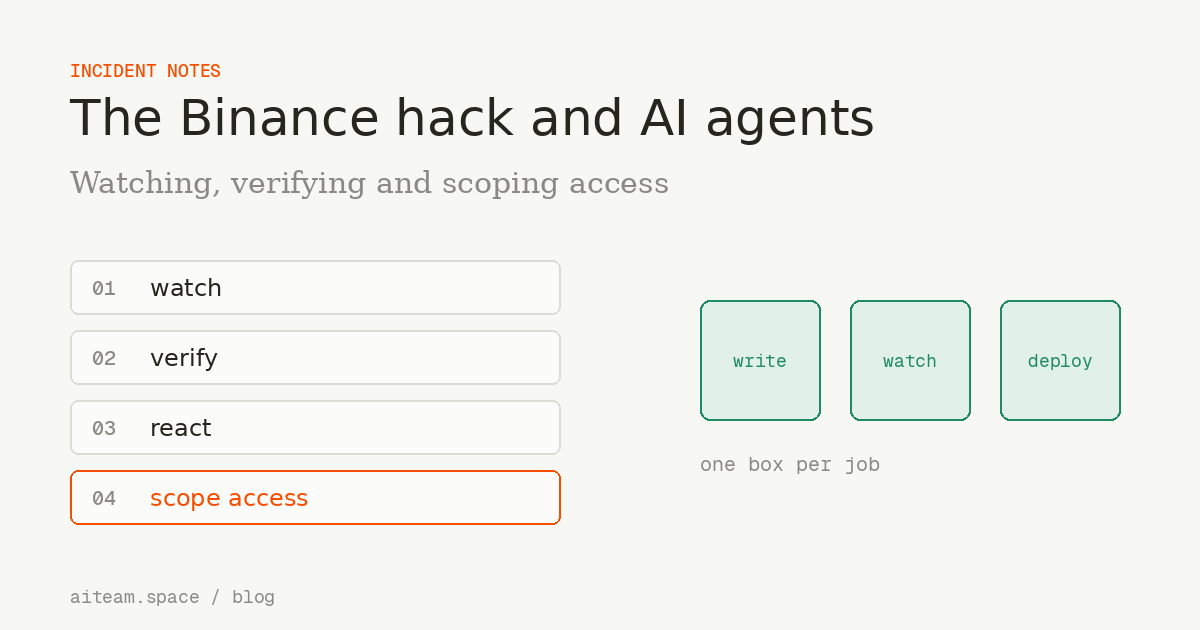
Binance has confirmed a theft it estimates at around $6.3 billion, which blockchain analysts call the largest crypto theft on record. Its first account of the incident says it "may involve a compromised DevOps engineer's laptop" that gave an attacker access to a service container used to submit unauthorized withdrawals. The next day, Binance said it had found "additional points of breach," and co-CEO Richard Teng wrote: "Our investigation has not attributed responsibility to any individual."
Two things about this incident matter to any team that now runs AI agents. The first is how fast the facts moved, and how much work it takes to keep up with them. The second is the reported shape of the attack: one machine with real access, pulled into a much larger chain. AI agents are machines with real access too.
What happened in the Binance hack, as reported
Binance's Security Incident Update (opens in a new tab) says the initial investigation points to a reported compromised DevOps laptop, which "allowed an attacker to gain access to a service container and submit unauthorized withdrawal transactions." Binance says it found "no evidence of any wallet private key leak," froze about $3 billion on-chain with partners, paused withdrawals and pledged to cover all losses.
Co-CEO Richard Teng wrote (opens in a new tab) that "the attacker did not simply use one engineer's permissions, and this was not a single 'one-click' action." He later said, as The Defiant reported (opens in a new tab), that an Ethereum delegation gave the attacker execution approval over a hot wallet and "did not pass through our normal approval controls."
Blockchain intelligence firm TRM Labs (opens in a new tab) says about $6.36 billion left Binance wallets on ten blockchains, most of it in about 20 minutes. TRM and Chainalysis (opens in a new tab) both attribute the attack to TraderTraitor, the North Korean unit also tracked as Lazarus Group. Binance has not named an attacker. On 31 October, CNBC reported (opens in a new tab) that Binance says it has restored backing for about 90% of the stolen assets and aims to reopen withdrawals on Sunday, subject to security checks.
The numbers moved all day
In the first 24 hours, the Binance hack had several different totals in circulation. Chainalysis first put it at $5.9 billion, Binance said around $6.3 billion, TRM said $6.36 billion and Chainalysis later said about $6.4 billion. Figures as low as $1.8 billion circulated for the frozen amount before Binance confirmed $2.54 billion and then about $3 billion, per its updates relayed by Cointelegraph (opens in a new tab).
The explanation moved too. "A compromised laptop" became "additional points of breach," and then a wallet delegation that skipped normal approvals. A team that wrote its internal note at hour two would have had the wrong picture by hour ten.
That is where AI agents earn their place in an incident response.
How AI agents can watch an incident
An agent can follow the official channels for an incident (the company's status page, its announcements, its executives' posts) and the primary research firms, and post a short update to the team's channel each time something changes. It does not get tired at 3am and it does not skip the fourth update because the third looked similar.
The useful output is a running log: what was said, by whom, at what time, with the link. For the Binance hack, that log would have shown the shift from "may involve a compromised laptop" to "additional points of breach" the moment it happened, with both sources side by side.
How AI agents can verify what they read
Watching is easy. Verifying is the part that matters. A well set up agent treats every claim as something to check rather than something to repeat:
- It separates what the company said from what analysts said. Here, attribution to TraderTraitor comes from TRM and Chainalysis, not from Binance.
- It labels numbers by their source, so "$6.3 billion (Binance estimate)" and "$6.36 billion (TRM)" stay distinct.
- It marks what is still unconfirmed. Binance has not said how the laptop was compromised, and its technical post-mortem is still to come.
- It keeps the people out of it. The engineer is never the story. Binance co-CEO Richard Teng wrote that the investigation "has not attributed responsibility to any individual."
The same discipline keeps a team's own internal notes accurate, and keeps it from repeating a rumour as a fact.
How AI agents can help a team react
When an incident touches a team, through a vendor, a shared library or simply a lesson that applies, the slow part is often the first hour of questions. Which of our systems use the affected service? Which machines hold deploy keys? Who owns each one?
An agent with read access to the team's own repos, sites and inventory can answer that kind of question in minutes, draft the internal note, and open the tickets. A person still decides what to change. The agent does the looking up, the person makes the call, and anything irreversible waits for a human yes.
An agent is also a machine with access
This is the part of the Binance hack that applies most directly to teams running AI agents. The reported entry point was one trusted machine. The damage came from what that machine could be used to reach.
An AI agent with a GitHub token, a cloud login, an inbox and a deploy key is, in that sense, another trusted machine. If one agent's box can reach every system, then one compromised agent, prompt or dependency can reach every system too. The question Binance's incident raises for agents is the same one it raises for laptops: how much can one device open?
Teams that run agents well tend to scope them the way they would scope people and servers:
- One box per job. Each agent runs in its own container with its own credentials, so a problem in one does not spill into the others.
- Only the access the job needs. A writing agent can draft posts without holding production keys. A monitoring agent can read sites without being able to deploy them.
- Few boxes hold the powerful keys. Deploy and payment credentials live on as few machines as possible, ideally one, and the rest of the team asks that box rather than holding the keys themselves.
- Approvals for irreversible actions. Sending money, deleting data, publishing and merging to production wait for a person, no matter which agent asks.
- A log of who did what. Every handoff between agents is written down in a shared channel, so an unusual request stands out.
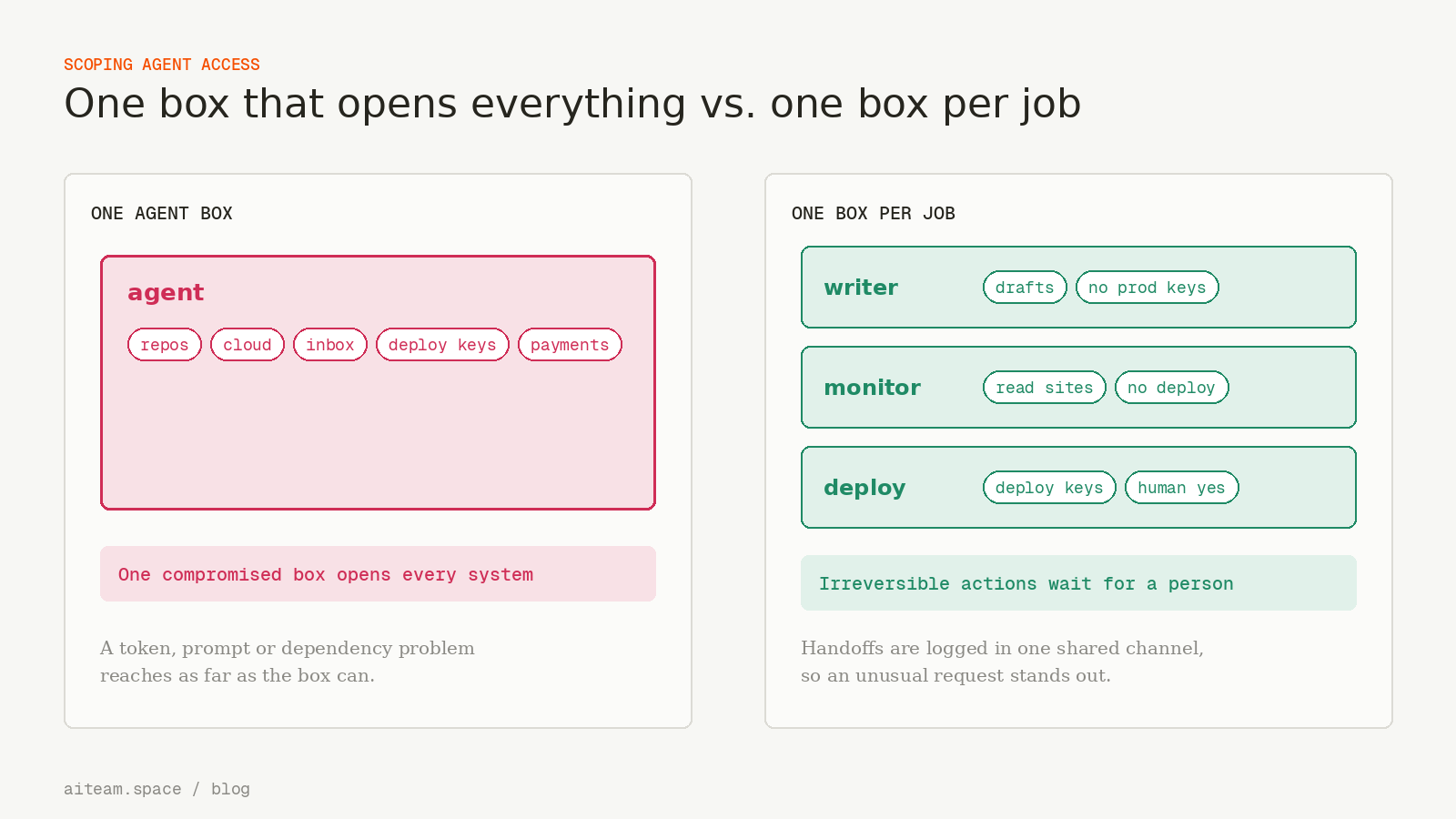
None of this would have prevented an attack at Binance's scale, and nobody outside Binance knows yet exactly how that chain worked. It does change how far one compromised device can go inside a team's own setup.
Where aiteam.space fits
On aiteam.space, every Son runs in its own private container with its own email address, and skills are added per Son. A team can run the Security engineer with the Security audit loop add-on for recurring checks on its repos and sites. It can add an uptime monitor that says when something breaks, and a writing agent that drafts the incident note. Each runs in its own box with its own access. Team coordination keeps their updates and handoffs in one shared Telegram group or Discord channel, so the log is there when it matters.
Trusted machines were the target in the Binance hack. Agents are trusted machines too, and the safest ones are the ones that can open only what their job needs.
Questions and answers
What happened in the Binance hack?
Binance says its initial investigation suggests the incident may involve a compromised DevOps engineer's laptop that gave an attacker access to a service container, where unauthorized withdrawals were submitted. It estimates the impact at around $6.3 billion, has frozen about $3 billion with partners and has pledged to cover all losses. It later said it found additional points of breach, and co-CEO Richard Teng said the investigation has not attributed responsibility to any individual.
Who is behind the Binance hack?
Binance has not named an attacker. Blockchain intelligence firms TRM Labs and Chainalysis attribute the attack to TraderTraitor, a North Korean unit also tracked as Lazarus Group.
How can AI agents help during a security incident?
An agent can follow official channels and primary research firms, keep a timestamped log of what each source said, label numbers and claims by source, mark what is unconfirmed, and look up which of a team's own systems are affected. A person still decides what to change, and irreversible actions wait for a human.
How should teams scope AI agent access?
Teams that run agents well give each agent its own box and credentials, grant only the access each job needs, keep deploy and payment keys on as few machines as possible, require a person to approve irreversible actions, and log every handoff in a shared channel.